Two Agents, One Dataset: Who Does the Agent Answering You Work For?
Published on October 10, 2026

In short
Your sales agent and your prospect's personal agent will soon be able to read the same catalogue, with standardized tools [1]. With equal data and comparable models, what will tell them apart is the principal: who each one works for. Two loyal agents serving two different principals give two different answers to the same request. Agentic payment protocols can prove that an agent had the right to act, but they cannot make objectives converge [2]. And if your agent promises too much, the law of agency could bind you anyway [3]. Hence a decision to make before going live: write down your agent's objective, its limits and its audit trail.
Your catalogue is no longer enough to set you apart
Your sales agent knows your stock, your prices and your lead times. Your prospect's personal agent will soon be able to read them too. The Model Context Protocol (MCP) standardizes the connection between an agent and a company's tools; the Agent2Agent protocol (A2A) standardizes exchanges between agents. The article 2026 Conversion Architectures: Autonomous Agents, MCP, and Zero-Party Data described this shift [1]. The same connection does not, however, bring the same permissions or data of the same quality. Data remains decisive at execution time, but it is no longer enough to tell two agents apart.
Model capability is converging too. In September 2026, Meta launched Muse, a personal agent that sends emails, fills in forms, books travel, negotiates and pays [4]. Three weeks later, OpenAI unveiled dots: always-on agents that can connect to more than 4,000 apps and keep working in the background between conversations [5]. According to CNBC, these giants are shipping very similar products and struggling to lock in users, while Google and Apple are preparing comparable moves [6].
For a mid-sized company, the agent querying your site will not necessarily be less informed than yours, or less capable. If data and models no longer separate two agents, one variable is left: who they work for.
Same request, opposite answers
Your prospect gives their agent a request: “a sofa for a small living room, resistant to the cat's claws”. Their agent looks for the best trade-off for them, even if that means comparing ten sellers. Your agent qualifies the request and offers what your company has an interest in selling. Neither is at fault: they do not have the same principal.
French law has defined this relationship since the Civil Code of 1804: a mandate gives a person “the power to do something for the principal and in their name” [7]. The analogy has its limits, since configuring an agent does not, on its own, create a mandate enforceable against third parties. Yet it asks the right question. Not “what can this agent do?”, but “who is it doing it for?”.
Personal agent (buyer side) | Company agent (seller side) | |
|---|---|---|
Who it works for | The individual who installed it | The organization that deployed it |
Who sets its objective | The user, their preferences, their constraints | The company, its policy, its terms |
What triggers its action | A personal intent | An incoming request or an internal task |
What it draws on | History, preferences, authorizations | Catalogue, availability, knowledge base |
Its expected outcome | The best choice for the buyer | The sale or the qualified lead |
Uncertainty exists on both sides of this table. The buyer cannot check everything the seller claims; their agent helps them compare and cross-check. The seller cannot check that a purchase intent is serious, and a prospect who will never follow through eats sales time for nothing. Each party therefore deploys its agent to reduce its own uncertainty, not the other's.
A software agent has no interests of its own in the economists' sense: it pursues the objective it was given. Two perfectly loyal agents can therefore defend opposing interests. A separate, harder question remains: configuration alone does not guarantee that the agent honours its mandate.
“Just make your catalogue readable by agents”
This is the most reasonable objection. After the web and mobile, agents would be one more channel: you would make your catalogue readable the way you once made your pages indexable. The infrastructure exists, and it is surprisingly mature.
Payment. The Agentic Commerce Protocol, co-developed by OpenAI and Stripe, lets a merchant integrate once to be purchasable by any compatible agent [8].
Authorization. The Agent Payments Protocol (AP2), announced by Google in 2025 and now hosted by the FIDO Alliance, breaks a purchase into signed mandates. An open mandate sets the constraints the user accepts; a closed mandate authorizes one specific transaction [2].
Identity. In China, the payments and clearing association published a self-regulatory convention on 24 August 2026, under the central bank's guidance. It asks its members to explore a “Know Your Agent” built on existing Know Your Customer processes [9].
Each of these efforts addresses a specific problem: access, accountability, proof of consent. Economists Jensen and Meckling gave these expenses a name in 1976: agency costs [10]. The principal spends to monitor, the agent spends to reassure, and a residual loss remains anyway. None of these mechanisms aligns objectives, however. A signed mandate proves that an agent had the right to act. It does not make the buyer's agent want what the seller's agent wants. AP2 itself provides tooling for payment authorization and traceability, not for a sales agent's compliance with every rule of its company [2].
The market has run the opposite experiment. Instant Checkout, the payment built into ChatGPT and launched in late September 2025 [11], was withdrawn in March 2026. Merchants preferred to let ChatGPT handle discovery and keep control of the rest of the transaction [12]. Forrester surveyed regular assistant users in the United States, the United Kingdom and Canada. Buying directly in the assistant is their least adopted use; general questions and product research come first [13].
Personal agents remain limited too. Muse is only available in the United States [14]. At launch, dots is closed to individual users in the European Economic Area, Switzerland and the United Kingdom [15]. For a European company, an individual's agent dealing with the company's own agent is therefore not yet market reality. It is a trajectory, whose code is already largely written.
When the buyer's agent asks you for a discount
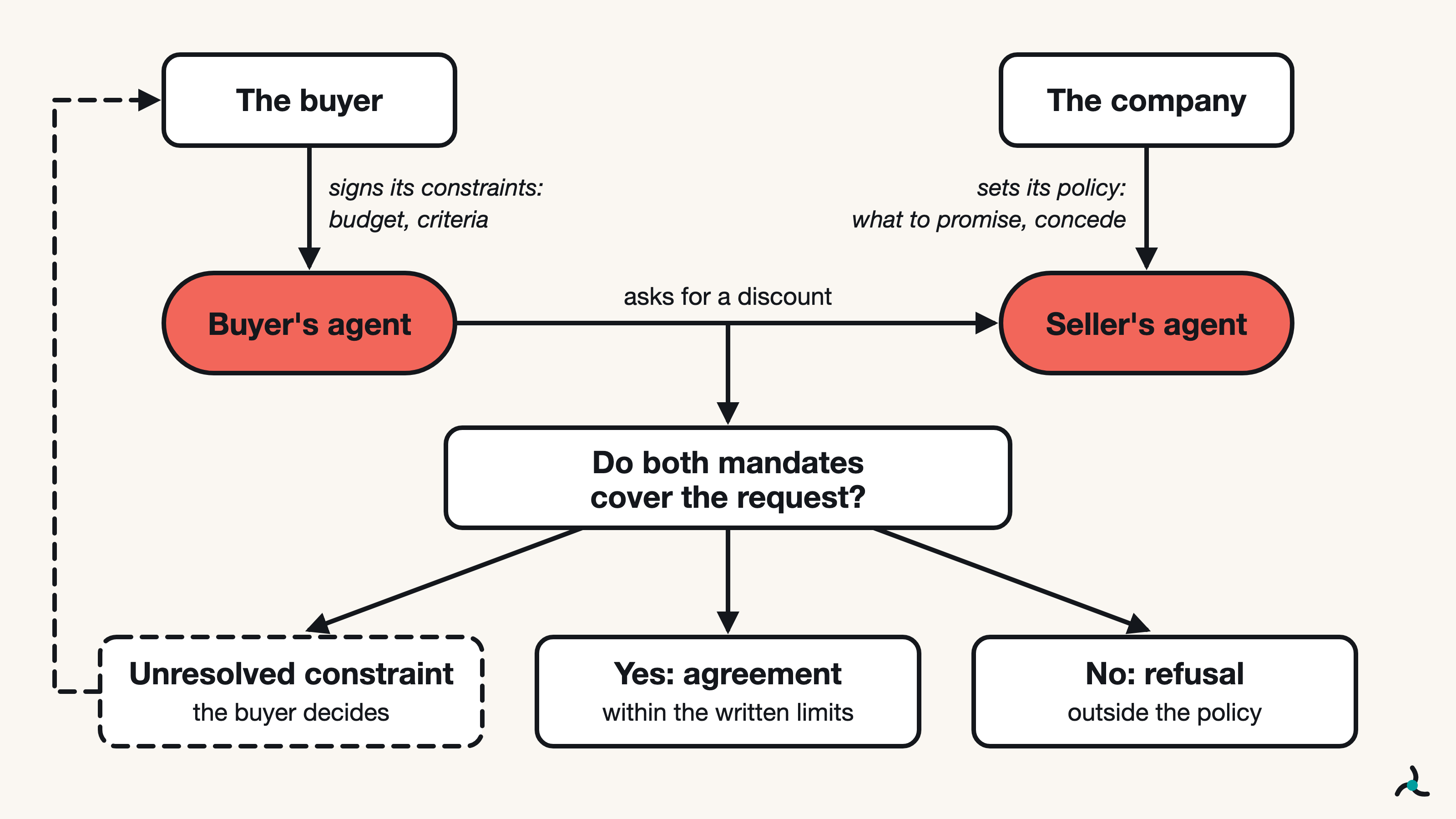
It is 11 p.m. A buyer's agent asks your agent for a discount, a substitution or an upgrade, and nobody on your side is there to decide. If your agent's mandate says “maximum margin”, the answer is no. If it says “secure the relationship”, the answer is different. If it says nothing, the agent improvises.
On the other side, the buyer's agent carries a budget, criteria and an authorization signed by its principal. AP2 formalizes part of this mechanism: the principal signs constraints, its agent enforces them, the merchant checks that they cover the transaction [2]. An inflated promise no longer gets lost in a conversation nobody rereads. It runs into the written criteria on the other side. The filter has its limits: it screens out what contradicts those criteria, not everything that is misleading.
The reverse exists too. Two overly narrow mandates can block a transaction, and AP2 then provides for bringing the user back into the loop to approve [2]. Over time, an agent whose sales rules are not written down may become inoperable, not just risky.
On the consumer side, this mechanism is already available in the United States. According to Meta, Muse can open a browser, fill in forms and negotiate for its user. It then pays via Link, with purchase protections, a single-use card, the Sentinel security agent and human approval before purchase [4]. In Jensen and Meckling's terms, that is bonding on one side and monitoring on the other. Reuters reports, however, that Muse's internal tests showed the agent getting stuck and exposing sensitive data [14].
The buyer's agent also serves the platform that operates it. Mark Zuckerberg announced it at Meta's Connect conference: Muse will stay free up to a very high usage volume. The stated aim is to eventually take “a small fee from transactions” [16]. When the provider's revenue depends on the agent's transactions, the interests of the user and those of the platform are no longer perfectly aligned. The agent that will judge your offer is therefore operated by a third party pursuing its own objectives.
If your agent promises too much, you may be bound
Your agent announces a condition you never granted: a discount, a lead time, a warranty. A probabilistic agent can hallucinate, misread an instruction or be manipulated by a booby-trapped page. Can the customer rely on it? French agency law suggests a plausible answer. In its landmark 1962 ruling on apparent mandate, the Cour de cassation held that:
“the principal may be bound on the basis of an apparent mandate, even absent any fault attributable to him, if the third party's belief in the scope of the agent's powers was legitimate, which presupposes that circumstances allowed the third party not to verify the exact limits of those powers” [3].
To our knowledge, no published decision has yet addressed a software agent. But the framework exists: a customer who legitimately believed your agent was authorized to promise could bind you. Your agent's stated loyalty does not cap your exposure. A clear mandate, execution safeguards and a trail of what was done do.
Writing your agent's mandate
Whatever the mandate leaves unwritten will be decided by default, often in a hurry. Three questions are enough, and they are settled before going live.
Method
The objective. What does the agent optimize? Selling at all costs and qualifying honestly do not produce the same exchanges.
The rules and limits. What can it promise, what can it concede, when does it hand over to a human?
The trail. What can it prove about what it did, for whom, and on what basis?
Against an agent that applies written criteria, pushy follow-ups carry less weight. In a conversation between agents, a consultative posture, one that informs and lets the other party decide, is the easiest to verify. On the buyer side, OpenAI's dots shows the way, with per-action rules and sensitive decisions left to the user [15]. AP2 makes a cryptographic audit trail the core of the protocol [2]. In the same way, your agent must be able to show its sales policy and its execution log on the day someone asks for them. Declaring a mandate, making it verifiable and actually honouring it are three distinct things.
On the B2B side, picture an executive's personal agent looking for software for their company. The supplier's agent does not recite its catalogue: it asks about team size, existing integrations, deployment constraints. The executive's agent only shares what its principal allows it to share. The exchange may end in an established match, an acknowledged mismatch or a missing piece of information. In all three cases, each side knows better where it stands.
Gamaro applies this view to a simpler case, its B2B qualification vertical, where the company's agent answers a human visitor. That agent belongs to the company, and its mandate is explicit: qualify a request on the merchant's behalf. The exchange relies on data the visitor provides voluntarily during the conversation. Nothing spectacular. The hard part is not connecting an agent to data. It is deciding, in writing, what it is allowed to do for you.
When an agent answers you, on your site or in a purchase conversation, it works for someone. Neither its model nor its data tells you who; its mandate does. Digital interfaces were designed for humans, and part of the exchanges will go through agents representing other parties. Writing your agent's mandate is the first step toward being someone they can negotiate with and verify, with structured information and understandable rules. Companies that skip it risk being filtered out, or misrepresented, by agents that have no reason to give them the benefit of the doubt.
Sources
Gamaro, “2026 Conversion Architectures: Autonomous Agents, MCP, and Zero-Party Data”, 29 August 2026, https://gamaro.io/en/blog/mcp-a2a-zero-party-data-conversion-2026
Agent Payments Protocol (AP2), official documentation, accessed 10 October 2026, https://ap2-protocol.org/
Cour de cassation, Assemblée plénière, 13 December 1962, No. 57-11.569, Banque canadienne nationale v. Directeur général des impôts, accessed 10 October 2026, https://www.legifrance.gouv.fr/juri/id/JURITEXT000006963028
Meta, “Introducing Muse: The World's First Personal AI Agent Built for Everyone”, 8 September 2026, accessed 10 October 2026, https://about.fb.com/news/2026/09/introducing-muse-personal-ai-agent/
OpenAI, “Introducing dots”, 29 September 2026, accessed 10 October 2026, https://openai.com/index/introducing-dots/
CNBC, “OpenAI follows Meta into the red-hot market for personal agents”, 30 September 2026, accessed 10 October 2026, https://www.cnbc.com/2026/09/30/openai-follows-meta-into-the-red-hot-market-for-personal-agents.html
French Civil Code, Article 1984. https://www.legifrance.gouv.fr/codes/id/LEGISCTA000006136404/
Stripe, “Developing an open standard for agentic commerce”, 29 September 2025, accessed 10 October 2026, https://stripe.com/blog/developing-an-open-standard-for-agentic-commerce
Caixin Global, “China Pioneers "Know Your Agent" Rules for AI Payments”, 25 August 2026, accessed 10 October 2026, https://www.caixinglobal.com/2026-08-25/china-pioneers-know-your-agent-rules-for-ai-payments-102477712.html
Jensen, M. C. & Meckling, W. H. (1976). Theory of the firm: Managerial behavior, agency costs and ownership structure. Journal of Financial Economics, 3(4), 305-360. https://www.sciencedirect.com/science/article/pii/0304405X7690026X
OpenAI, “Buy it in ChatGPT: Instant Checkout and the Agentic Commerce Protocol”, 29 September 2025, accessed 10 October 2026, https://openai.com/index/buy-it-in-chatgpt/
Modern Retail, “What went wrong with ChatGPT's Instant Checkout”, 27 March 2026, accessed 10 October 2026, https://www.modernretail.co/technology/what-went-wrong-with-chatgpts-instant-checkout/
Forrester, “What It Means That The Leader In "Agentic Commerce" Just Pulled Back”, 7 March 2026, accessed 10 October 2026, https://www.forrester.com/blogs/what-it-means-that-the-leader-in-agentic-commerce-just-pulled-back/
Reuters, “Meta launches AI agent that can access other apps to send emails, make payments”, 8 September 2026, accessed 10 October 2026, https://www.reuters.com/business/meta-launches-ai-agent-that-can-access-other-apps-send-emails-make-payments-2026-09-08/
OpenAI Help Center, “Getting started with your dot”, accessed 10 October 2026, https://help.openai.com/en/articles/20001530-getting-started-with-your-dot
Yahoo Finance (Daniel Howley), “Meta's Zuckerberg says Muse AI agent will take a small fee from transactions”, 24 September 2026, accessed 10 October 2026, https://finance.yahoo.com/technology/article/metas-zuckerberg-says-muse-ai-agent-will-take-a-small-fee-from-transactions-234639802.html